
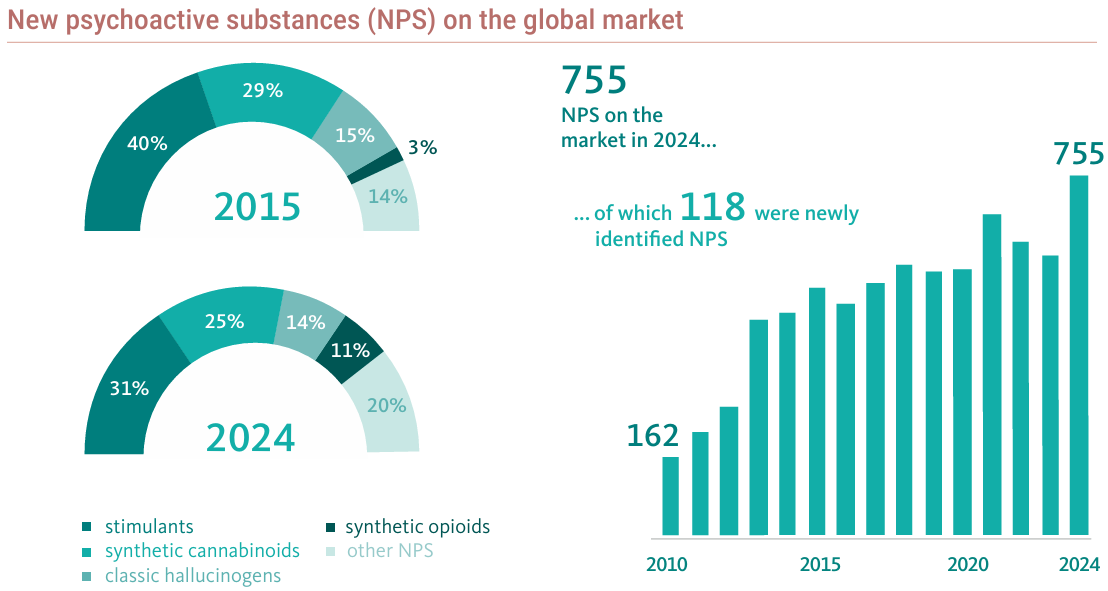
The increasing availability of novel synthetic opioids comes at a time when there are severe constraints on the illicit production of heroin, together, these circumstances could reshape global illicit opioid markets, turning them away from opiates and towards synthetic opioids resulting in profound implications for drug policy, drug use and drug harm.
Global drug use
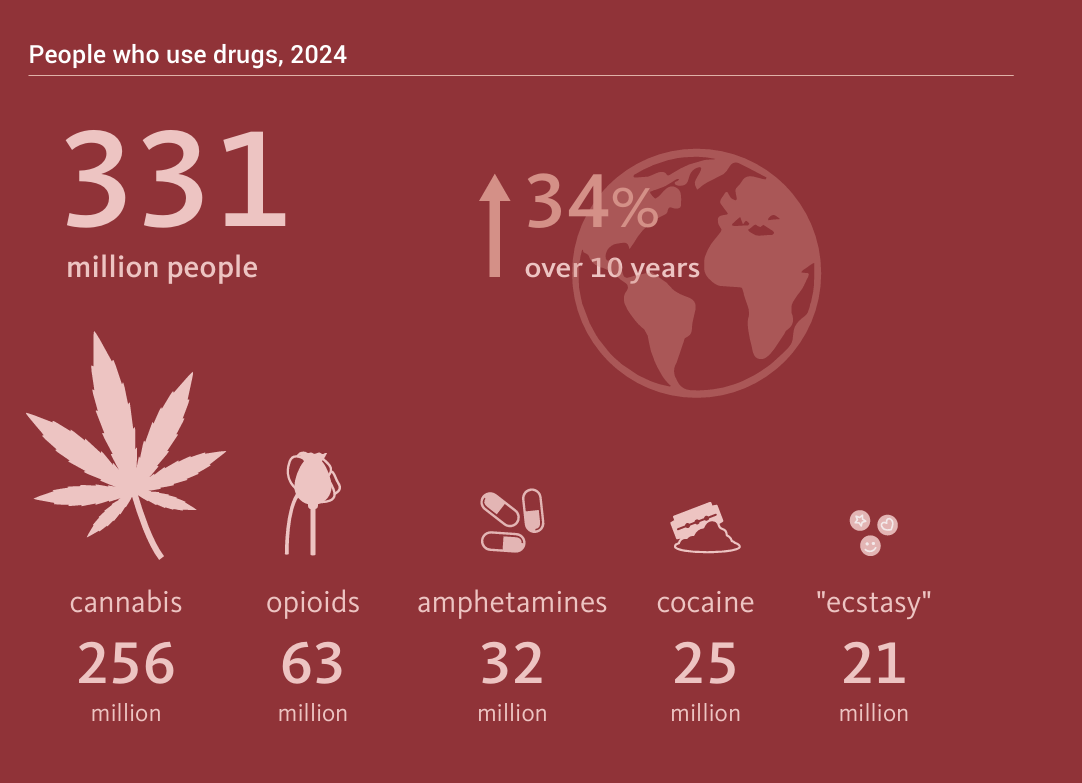
Drug use continues to increase worldwide. In 2024, 331 million people were estimated to have used a drug in the past year, or 6.2 per cent of the global population aged between 15 and 64. This is 34 per cent more than a decade ago and is partly a result of around 10 per cent growth in population, but it also reffects an increase in the prevalence of drug use from 5.2 per cent in 2014, and the availability of new and more accuratedata.About three quarters of people who use drugs are men, and the use of drugs remains most concentrated among younger age groups.
Cannabis remains the most used drug and its use is increasing; it is now used by an estimated 256 million people globally. The number of people using cannabis has grown by 40 per cent over the past decade, while the prevalence of its use increased from 3.8 per cent in 2014 to 4.8 per cent in 2024.
Despite recent changes in supply in some parts of the world, opioid use appears to have remained rather stable globally, with an estimated 63 million people using opioids, almost half of those using opiates, in 2024.
An estimated 32 million people used amphetamines in 2024.
In 2024, an estimated 25 million people used cocaine worldwide, which is 38 per cent more than a decade ago.
An estimated 21 million people used“Ecstasy”in 2024 at the global level.
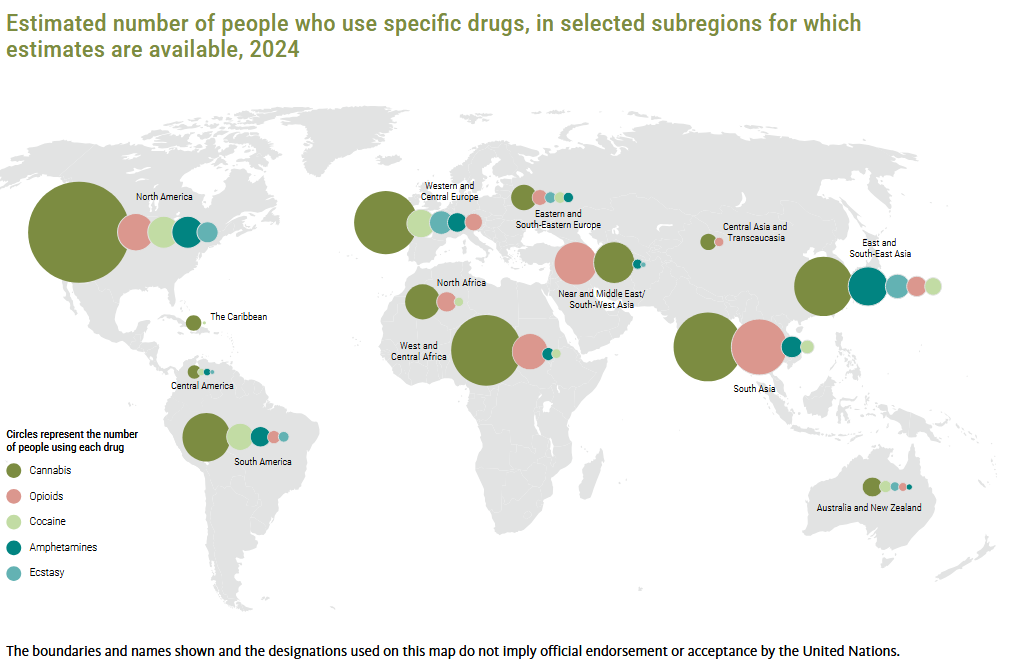
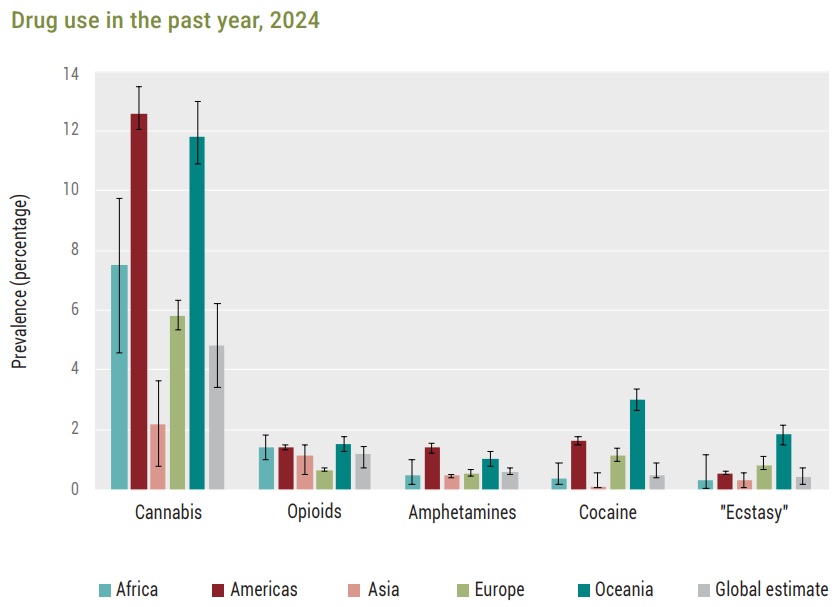
The Americas and Asia are home to the largest number of people who use drugs (105 million in each region), followed by Africa (74 million), but the highest prevalenceof drug use is found in Oceania (15.5 per cent) and the Americas (15 per cent), followed by Africa (8.6 per cent).
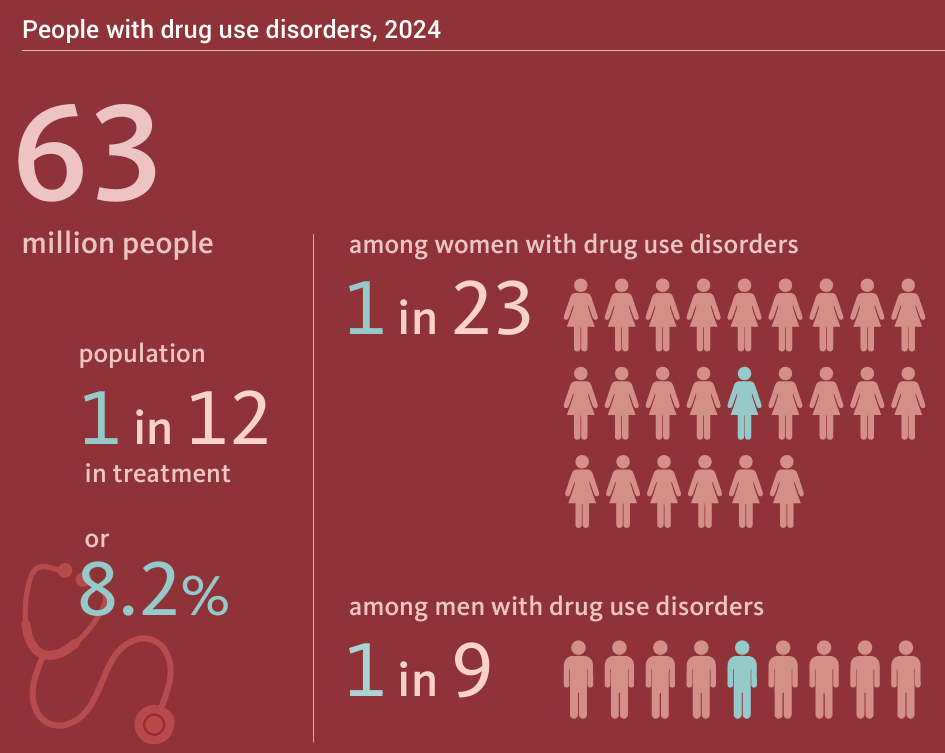
In 2024, an estimated 63 million people were suffering from drug use disorders worldwide.Over the period 2020–2024, Member States reported the highest number of people suffering from drug use disorders in relation to opioids (mostly heroin and misused pharmaceutical opioids), followed by cannabis, cocaine and amphetamine-type stimulants.
Only 1 in 12 of those who suffer from drug use disorders received some form of drug-related treatment in 2024.At the global level, in 2024, only 1 in 23 women who suffered from drug use disorders were estimated to be in drug treatment, compared with 1 in 9 men.
Drug markets
The coun try was long the world's dominant source of heroin until 2022, when it began enforcing a ban on drug production in 2023. Since then, cultivation and production have collapsed by 95 per cent. In 2025, cultivation remained well below pre-ban levels at 10,200 hectares, a fraction of the estimated 232,000 hectares cultivated in 2022. Total opium production remains just as disrupted, shrinking from 6,200 tons in 2022 to an estimated 296 tons in 2025.
So far, illicit poppy cultivation and opium production in other countries regularly monitored by UNODC (i.e., Lao People’s Democratic Republic, Mexico and Myanmar)have not indicated any substantial increase in cultivation that would replace declining outputs from Afghanistan. Although the illicit production of opium in Myanmar has increased in recent years, from about 420 tons in 2021 to over 1,000 tons in 2025, making it the largest global producer of illicit opium, there is no evidence that this is in response to a decline in productionin Afghanistan.
A perceived or actual disruption in the supply of heroin to major consumer markets will encourage trafffckers to seek alternatives. This could, in turn, displace the illicit cultivation of poppy and illegal production of opium to other countries or encourage a shift to syntheticsubstitutes, such as fentanyls and nitazenes, or other novel synthetic opioids – or perhaps even to non-opioid substances.
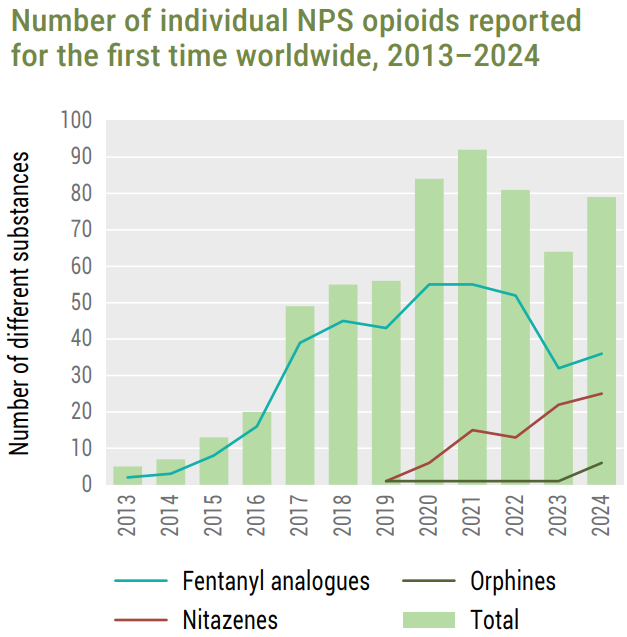
Nitazenes have been identified across 37 countries since 2019, making them far more geographically widespread than fentanyls ever have been.
In the United Kingdom, between June 2023 and August 2025, nitazenes were linked to approximately 750 overdose deaths.
In the United States, nitazeneswere attributed to 338 overdose deaths in 2023 and 409 deaths in 2024.
Clusters or signiffcant numbers of deaths and acute toxicity cases linked to nitazenes have also been reported in France, Germany, Latvia, Sweden and Norway.
Nitazenes have recently been sold as falsiffed opioids (e.g. oxycodone, buprenorphineor tapentadol) or benzodiazepines (e.g. alprazolam) .
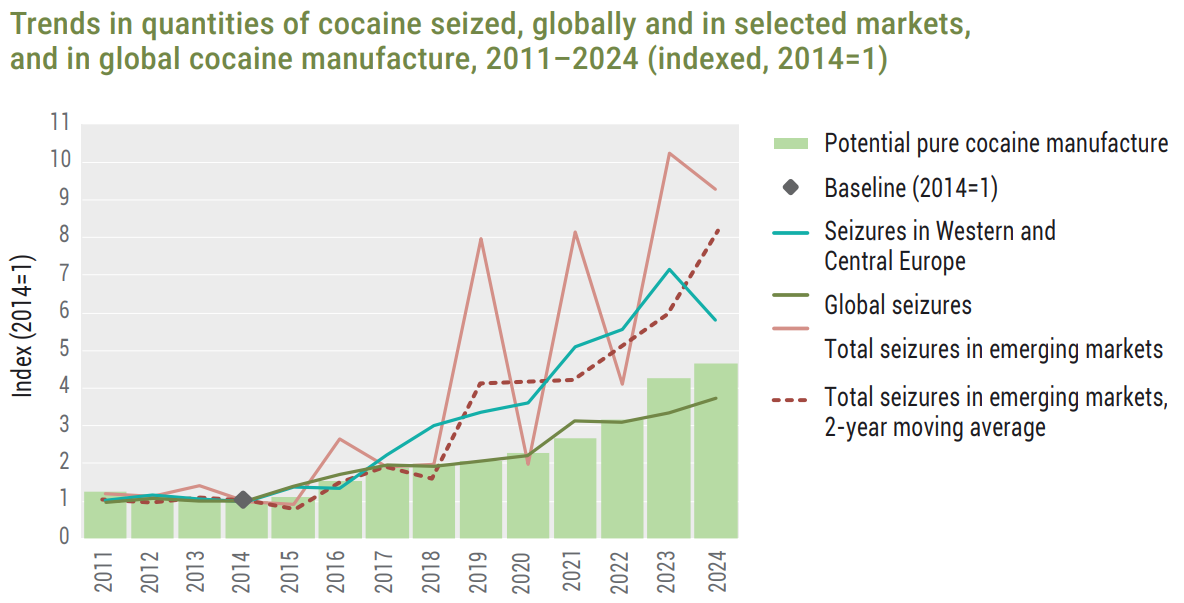
Since the most recent low point in 2014, the potential manufacture of pure cocaine has grown more than fourfold to over 4,000 tons in 2024, driven largely by increases in the area under cultivation and in productivity.
Cocaine users remain concentrated in a number of established markets, with the Americas, Western and Central Europe, Australia and New Zealand accounting for approximately 70 per cent of past year users.
Certain countries in Africa and Asia were among the countries with the highest rate of growth in seizures worldwide during the period 2020–2024.
The global cocaine market continues to experience strong growth in supply and demand, with both established and emerging markets being affected.
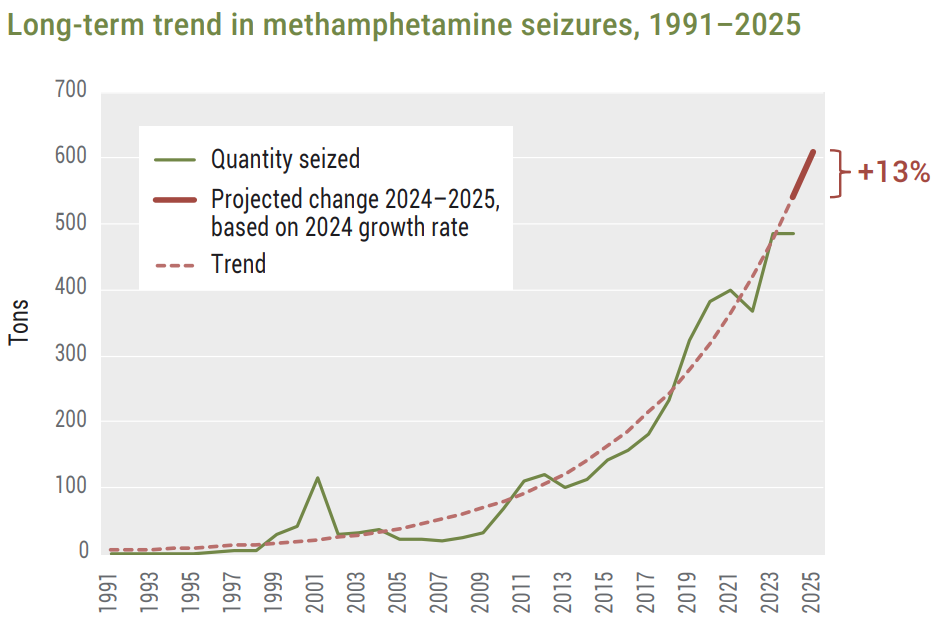
Although annual seizure quantities are subject to ffuctuations,the trend in global methamphetamine seizures suggests an approximate annual growth rate of 13 per cent, as of 2024. This increase continues to be driven by quantities seized in East and South-East Asia.
As of 2024, methamphetamine users constituted approximately 3.2 per cent of past-year users of any drug in the United States, but 5.6 per cent of people with a drug use disorder and 17.4 per cent of people with a severe drug use disorder (the last ffgure being slightly higher than the corresponding percentagefor opioids, and almost triple the percentage for heroin).
The potential for harm extends to other regions where the market is still developing, including transit and production countries, as has already been experienced in countries such as Mexico, where treatment provision for methamphetamine use disorders rose 25-fold over the period 2015–2023, reflecting increasing harm at the domestic level. That increase was matched by a sevenfold increase in emergency room admissions related to stimulants other than cocaine (including methamphetamine) over the same period.
Another example of a developing market is Europe; based on data for the European Union together with Norway and Türkiye, 22 per cent of treatment entrants for methamphetamine reported injecting as a route of administration, in addition to 48 per cent of treatment entrants who reported smoking or inhaling as a route of administration.
The change of government in the Syrian Arab Republic in late 2024 resulted in a profound change in the “cap tagon” market, whose ripple effects are likely still playing out. According to the country’s authorities, since December 2024, 16 laboratories, mostly of indus trial scale, have been dismantled in the country, as have 15 facilities for storage, suggesting that a long-standing production stream of “captagon” was severely dis rupted.Following the disruptions of late 2024, the weakening of such networks and the realignment of alliances in the region likely facilitated significant law enforcement successes close to the border between Lebanon and the Syrian Arab Republic. As an immediate conse quence, the price of a “captagon” tablet sold in Lebanon more than doubled, from $2 to $3 per pill to $5 to $7 per pill.
In the Arabian Peninsula, historically a major market for “captagon”, metham phetamine (referred to informally as “shabu”) was linked to drug overdoses in the late 2010s. In Saudi Arabia, methamphetamine use, which is believed to have taken root among people who used “captagon”, appears to have increased, and methamphetamine is currently assessed to be among the three most com monly used drugs, alongside cannabis and “captagon”.